

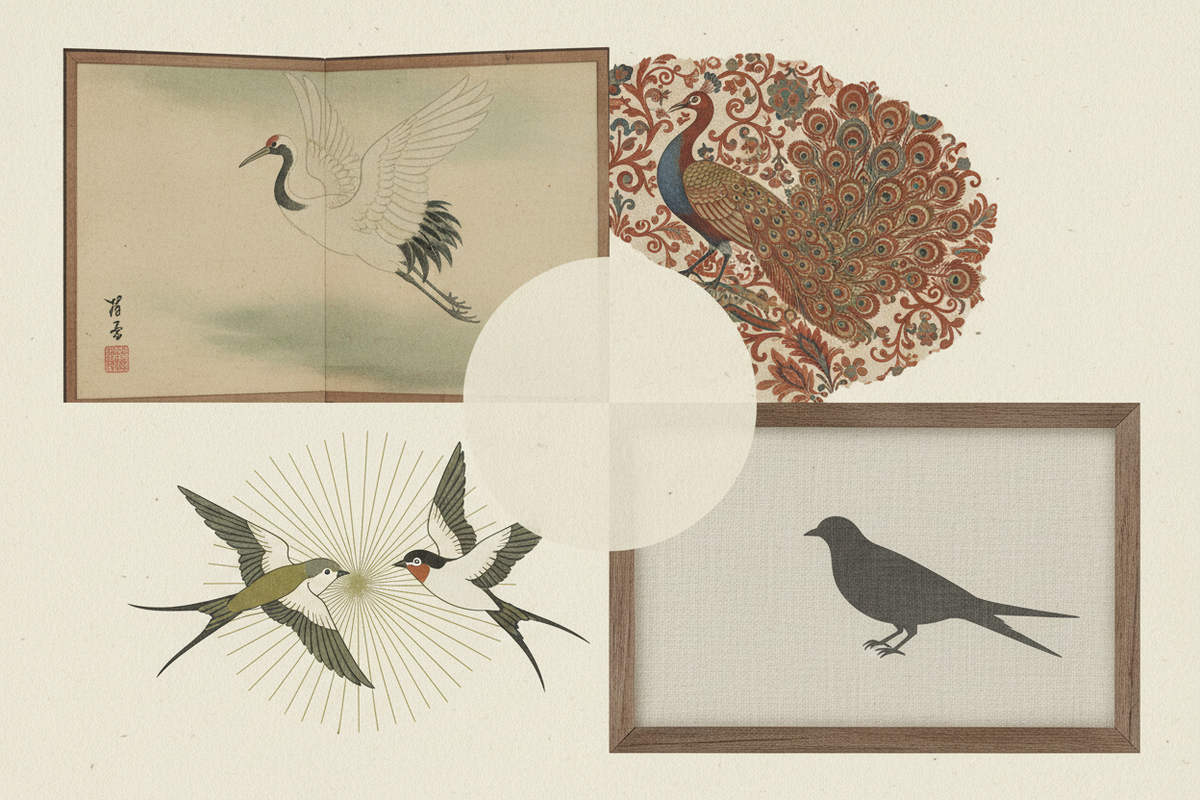
Birds have decorated human homes for roughly 40,000 years, longer than almost any other decorative motif still in use today. Long before bird figurines sat on farmhouse shelves, birds were painted on cave walls, carved into ancient pottery, and woven into the mythology of nearly every culture on earth. The appeal has never really changed: birds represent freedom, renewal, and a connection between the everyday and something larger.
The Earliest Bird Imagery
Some of the oldest known cave paintings, including work found in Lascaux, France, dating back roughly 17,000 years, include bird figures alongside the more famous horses and bison. Archaeologists believe these early bird images carried spiritual weight, often linked to shamanic practice, since birds were seen as creatures able to move between the earthly world and the sky above it. That idea, a bird as messenger between two realms, shows up again and again across cultures that had no contact with one another, which is part of why bird symbolism feels so universal even today.
Birds in Ancient and Classical Cultures
Ancient Egypt gave birds an outsized role in its visual and religious world. The falcon-headed god Horus represented kingship and the sky, while the ibis was sacred to Thoth, the god of wisdom and writing. In Greek and Roman mythology, the eagle was Zeus's own bird, a symbol of authority and divine power, an association that carried forward into Roman military standards and, much later, into national emblems still used today. Doves appear across Mediterranean cultures as symbols of peace and devotion, an association so old it predates the biblical story of Noah's dove returning with an olive branch.
Birds in Folk Art and Early American Decor
By the time European folk art traditions reached colonial and early American homes, birds were already a fixture of decorative painting, textiles, and woodwork. Pennsylvania Dutch hex signs frequently featured birds as symbols of good fortune, and the distelfink, a stylized folk-art finch, became one of the most recognizable motifs in Pennsylvania German decorative arts, painted onto furniture, birth certificates, and barns alike. Weathervanes shaped like roosters and eagles topped American homes and barns for generations, serving as both function and ornament. These pieces set the template for what bird decor still does today: mark a home as cared for, rooted, and a little bit hopeful.

From Victorian Parlors to Modern Farmhouse Shelves
Victorian-era homes leaned heavily into bird imagery, from taxidermy displays to elaborate ceramic figurines and wallpaper prints, reflecting the era's broader fascination with natural history and collecting. That enthusiasm faded through the mid-20th century as decor trends turned sleeker and more minimal, but bird motifs never fully disappeared. They resurfaced strongly with the farmhouse and cottagecore movements of the last two decades, this time paired with reclaimed wood, stoneware, and greenery rather than Victorian excess. A piece like our Ceramic Blue Bird reflects that same lineage in a modern form, simple, hand-finished, and equally at home on a farmhouse shelf or a coastal mantel.

Today's bird decor, the kind you'll find on a modern farmhouse mantel or a coastal-style shelf, draws a straight line back to those same instincts: a bird as a small, everyday reminder of nature, freedom, and home. Pieces like our Moss Covered Bird's Nest tie that history directly to spring and renewal, the same seasonal symbolism that's followed the nest motif for thousands of years.

Why the Motif Still Resonates
Across nearly every culture and every century, birds have represented some version of the same handful of ideas: freedom, since they move through the sky unbound; renewal, tied to migration and spring; and connection between the ordinary and the sacred. That consistency across thousands of years and unrelated cultures is rare for any decorative motif, and it's likely why bird decor has never really gone out of style, only changed its material and setting. A ceramic bird on a farmhouse shelf today is doing the same emotional work a painted bird did on a cave wall 17,000 years ago.
Ready to bring a piece of that history into your own home? Browse our full bird decor collection, or see our room-by-room styling guide for where each piece works best.
Frequently Asked Questions
What do birds symbolize in home decor?
Birds most commonly symbolize freedom, renewal, and a connection between everyday life and something larger. Specific species carry more particular meanings, doves for peace, owls for wisdom, and hummingbirds for joy, but the broad appeal of bird decor rests on that sense of freedom and hope.
How old is bird imagery in human art?
Bird imagery appears in some of the oldest known cave paintings, dating back roughly 17,000 years, making it one of the longest-running decorative motifs in human history.
What is a distelfink?
A distelfink is a stylized folk-art finch that became one of the most iconic motifs in Pennsylvania Dutch decorative art, painted onto furniture, textiles, and documents as a symbol of good fortune.
Why is bird decor popular in modern farmhouse style?
Bird motifs pair naturally with the natural materials, like wood, stoneware, and greenery, that define modern farmhouse style, and they carry the same folk-art history that inspired the farmhouse aesthetic in the first place.
What does an eagle symbolize compared to a dove?
An eagle traditionally symbolizes strength, authority, and vision, tracing back to its association with Zeus in Greek mythology and later national emblems. A dove symbolizes peace, purity, and new beginnings, an association that goes back to ancient Mediterranean cultures and the biblical story of Noah.


