

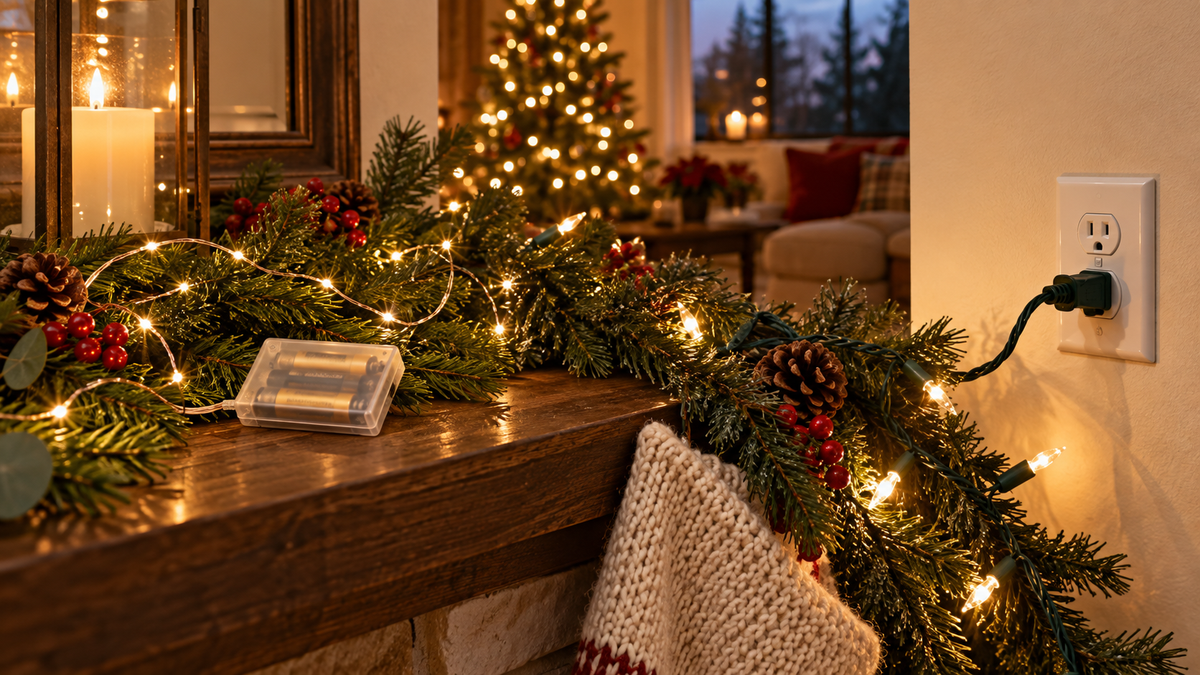
The right choice between battery-operated and plug-in Christmas lights comes down to one question: is there an outlet within reach of where you want the lights? If yes, plug-in almost always wins on brightness and reliability. If not, battery-operated opens up spots a cord never could. Here's how to decide, room by room.
Plug-In Lights: Brighter, Steadier, More Permanent
Plug-in LED lights draw continuous power, so they run brighter and hold that brightness for the full season without dimming. They're the better choice for anywhere you want the display running for hours at a time, like a front window, a mantel, or an outdoor roofline. Our 20' LED String Lights, Electric are a straightforward, dependable pick for exactly this kind of always-on display.

The trade-off is the cord itself: you need a nearby outlet, and a visible cord can be its own styling problem on an open shelf or a garland that doesn't run near a wall. For most of our customers decorating a full tree, mantel, or storefront window here in Blowing Rock, plug-in remains the default, and it's what most of our LED Christmas lights collection is built around.
Battery-Operated Lights: Freedom From Outlets
Battery-operated lights run on AA or AAA batteries housed in a small pack along the string, which means no cord, no outlet, and no visible power source. That makes them the only realistic option for a few specific spots: a wreath on a door with no nearby outlet, a garland running across a mantel where a cord would be the only ugly thing in the room, or a small vignette on a shelf or windowsill away from a plug. Our 20' LED String Lights, Battery and 15-Ft. LED Battery-Operated Cluster Lights with Remote both cover this ground well, the cluster style especially useful for filling out a garland fast.

The trade-off is battery life. Even LED battery packs typically run 6 to 8 hours a day on a timer setting before batteries need replacing, and they're generally a step dimmer than plug-in equivalents. For anything you want lit all evening every night through the season, factor in the cost and hassle of battery changes.
Where Each One Makes Sense
Think in terms of duration and location rather than a blanket preference. Plug-in suits anywhere the lights run for hours nightly and a nearby outlet exists: trees, rooflines, storefront windows, mantels with an outlet behind them. Battery-operated suits anywhere a cord isn't practical or wouldn't look right: wreaths, garlands without nearby outlets, and small tabletop displays. Many of our customers use both in the same room, plug-in on the tree and battery-operated on the mantel garland, so the choice doesn't have to be all-or-nothing.

If your battery-powered pieces are going outdoors, confirm the pack itself is weather-rated, not just the light strand. We cover weatherproofing in more depth in our guide to outdoor LED lights.
Battery Life and Upkeep Tips
A few habits stretch battery life considerably. Use a built-in timer function if the set has one, since most battery packs include a 6-hour-on, 18-hour-off cycle that's enough for evening display without draining batteries during the day. Lithium AA batteries last noticeably longer than standard alkaline in cold weather, which matters if the piece is anywhere near an unheated porch or entryway. And swap batteries as a set rather than mixing old and new, since one weak battery in a series will dim the whole string.
Frequently Asked Questions
What are the drawbacks of battery-operated Christmas lights?
The main drawbacks are dimmer output compared to plug-in, and the ongoing cost and hassle of replacing batteries through the season. They're also typically shorter runs, so covering a large area usually takes several battery-powered strands linked together rather than one long plug-in strand.
How long will battery-operated Christmas lights last?
On a standard timer setting of about 6 hours a day, alkaline batteries typically last 2 to 4 weeks before needing a change, depending on the light count and battery quality. Lithium batteries last noticeably longer, especially in colder temperatures.
Are battery-operated lights worth it?
They're worth it specifically for spots without a nearby outlet, like wreaths, garlands away from walls, or small tabletop displays. For anywhere with easy outlet access, like a tree or a roofline, plug-in is generally the better value since you avoid the ongoing cost of batteries.
Is it safe to leave Christmas lights plugged in all day?
LED plug-in lights run cool and are generally safe to leave on for extended periods, though a timer is still the safer habit for both energy use and peace of mind. Always check that any set you're using outdoors is rated for outdoor use, and avoid running lights unattended overnight on older or non-LED sets.
Can I mix battery-operated and plug-in lights in the same display?
Yes, this is common and often the most practical approach. Use plug-in for the main tree or roofline where an outlet is close, and battery-operated for accent pieces like wreaths, garlands, or centerpieces where a cord isn't an option.
Not sure which style fits your space? Browse our full LED Christmas lights collection, which includes both plug-in and battery-operated options, or stop by our Main Street shop in Blowing Rock and we'll help you match the right lights to the right spot.


